
By George Kaminsky
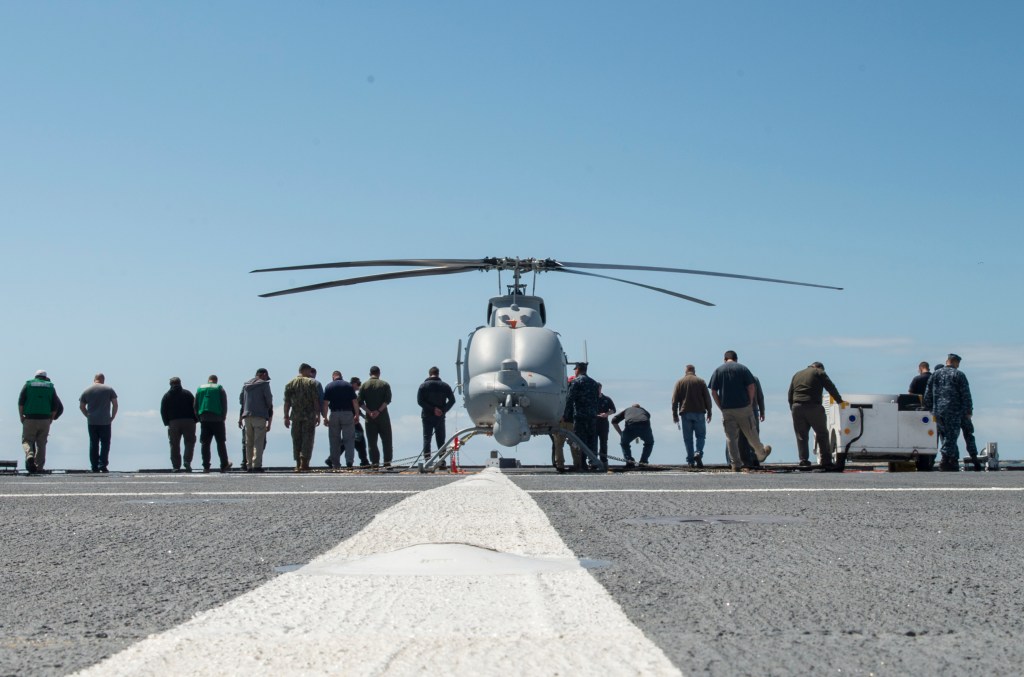
The Navy has transferred four MQ-8C Fire Scout helicopters to the Army’s Redstone Test Center, a move that saved the Army just over $70 million in procurement costs and gave the service a head start on testing large unmanned rotorcraft. The Navy’s PMA-266 program office announced the transfer on Oct. 22.
Ground testing is complete, and flight tests are now under way at two sites: Dugway Proving Ground in Utah and Redstone Arsenal in Alabama. The Army is using the aircraft to explore how an unmanned helicopter fits into its aviation formations, from sensing to over-the-horizon targeting.
The path from request to flying aircraft moved quickly. In January 2025, the Army asked for four aircraft, two mobile mission control systems and spare engines. Approval came in May 2025, and the aircraft were delivered by July 2025. Communications security equipment arrived in July 2026, and flight tests began about a month later. Counting from the transfer to flight testing, the transition took 14 months.
That timeline shows the value of using what already exists. Instead of buying new aircraft and waiting for production, the Army took airframes that the Navy had already purchased and put them to work. The savings of just over $70 million come from avoiding that new procurement, and the Army gets real aircraft in the hands of its test pilots and engineers sooner.
Chief Warrant Officer 4 Taylor Kiel and Col. Leigh Irwin both spoke about the program, highlighting how the transfer lets the Army gather data on unmanned helicopter operations without waiting for a new system to be built. Their comments pointed to the same theme: learning by flying is faster than learning from paper studies.
The MQ-8C is built by Northrop Grumman on a Bell 407 airframe. It can stay aloft for up to 12 hours, a long time for a helicopter, and the Navy reached initial operational capability with it in 2019. It carries the Leonardo Osprey AN/ZPY-8 radar, which gives it a strong ability to search and track over wide areas. The Navy bought 38 of the aircraft, making it one of the more substantial unmanned helicopter fleets in U.S. service.
For the Navy, the Fire Scout has been a ship-based eye in the sky, helping surface vessels see farther and gather information without risking a crew. Its ability to take off and land vertically allows it to operate from small decks and from rough, unprepared areas. Those same traits suit the Army, which often needs to operate from austere locations and to place sensors far forward.
The Army’s interest connects to a broader shift in how it plans to use aviation. The service is working on manned-unmanned teaming, in which aviators fly with unmanned aircraft and can control their sensors directly. That approach could allow a crew to see a target beyond the horizon without exposing itself, and to pass information to artillery or other forces. A large, long-endurance helicopter such as the MQ-8C offers a way to test those ideas at a scale and range that smaller drones cannot match.
Flight tests at Dugway and Redstone give the Army different conditions to learn from. Dugway, in the Utah desert, offers wide restricted airspace and open ground. Redstone Arsenal is home to a major Army testing and aviation community. Together, they allow engineers to examine performance, communications and control in varied terrain and weather.
The two mobile mission control systems matter as much as the aircraft. They provide the ground stations that operators use to plan missions, monitor the aircraft and handle sensor data. Testing the entire chain, from air vehicle to control station to communications, lets the Army see how the system works as a whole and identify what soldiers will need to run it.
The transfer also offers a model for cooperation among the services. The Navy had aircraft and expertise in operating them, and the Army had a requirement and a test organization ready to use them. By sharing, both gain: the Navy’s investment continues to serve a purpose, and the Army avoids a large expense and a long wait. The 14-month transition from transfer to flight testing, though involving equipment delivery steps along the way, shows that such arrangements can move quickly when the services work together.
For soldiers, the practical result will depend on what the tests find. Data from the flights will help the Army decide how an unmanned helicopter might serve, whether for reconnaissance, targeting, communications relay or other roles. It will also inform decisions about training, maintenance and the control interfaces that aviators and operators need.
The next steps are the flights themselves. As the Army builds hours on the four aircraft at Dugway and Redstone, it will gain a clearer view of how large unmanned helicopters can support its aviation and ground forces. With the aircraft already in hand and the savings already realized, the Army is in a position to learn quickly and shape its future unmanned rotary-wing plans on the basis of real experience.
Source: Navy PMA-266 via DVIDS, October 22, 2026. Photo: U.S. Navy.



Leave a Reply