
By George Kaminsky
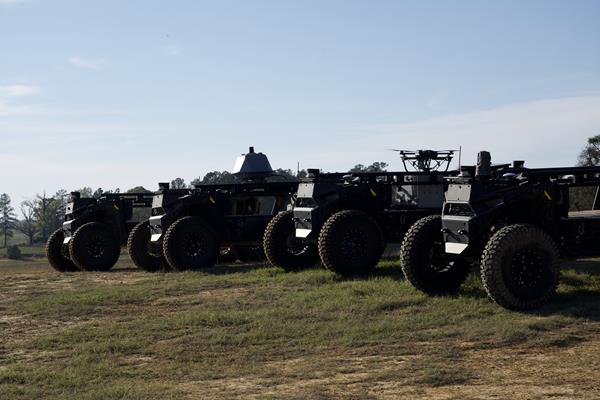
Overland AI used the Association of the United States Army annual meeting to show how far its ULTRA unmanned ground vehicle has come. The four-by-four robot appeared at the Leonardo DRS booth in several mission configurations, including one carrying the company’s Multi-Mission Hemispheric Radar for detecting and tracking aerial threats.
ULTRA is built for the work soldiers want robots to take on first: carrying loads, scouting ahead and doing it without a driver in the seat. The manufacturer lists a 1,000-pound payload, a top speed of 35 miles per hour and a 114-horsepower engine, in a package with a gross weight of 3,500 pounds. It measures about 13 feet long, six feet wide and five feet high, with 14.5 inches of ground clearance. The vehicle can be moved by CH-53 or Chinook helicopter or by C-130 aircraft, and it provides a NATO-standard 24-volt connection and up to five kilowatts of power for mission equipment.
The autonomy comes from Overland AI’s own software. OverDrive and SPARK equipment let the vehicle navigate off-road terrain without GPS and without constant input from a driver, and OverWatch lets soldiers assign and monitor missions. That combination matters in the places the Army expects to operate, where satellite navigation can be jammed and radio links are limited.
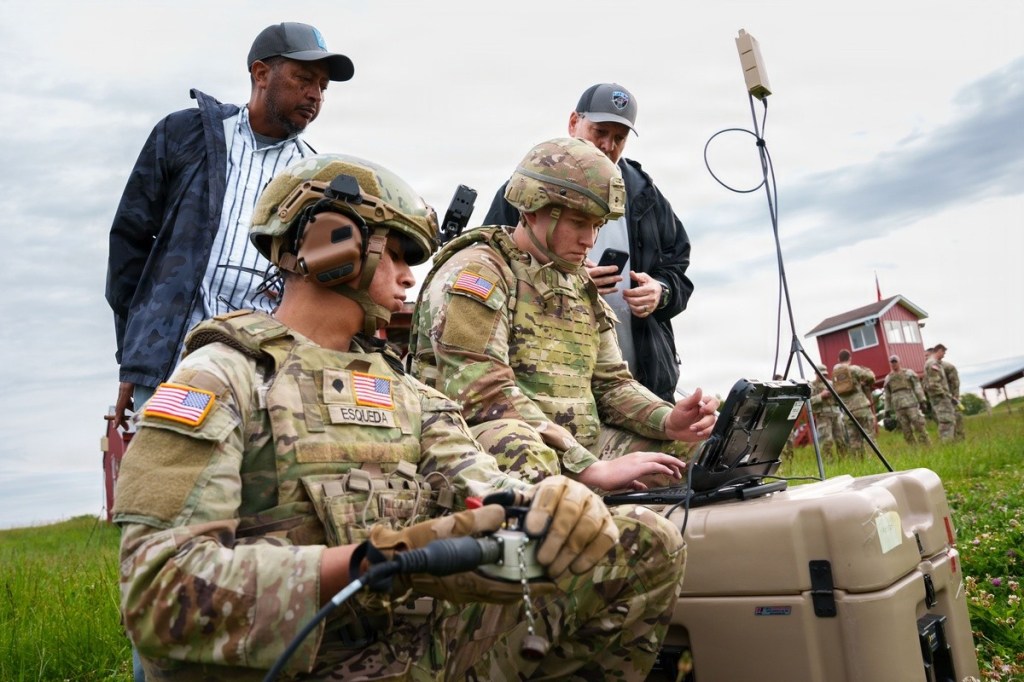
The Army has been putting ULTRA through real training. On Jan. 29, soldiers from the 1st Battalion, 505th Parachute Infantry Regiment operated the vehicle during Panther Avalanche at Fort Bragg. The imagery from that event comes from official Defense Department sources, and it gave paratroopers early hands-on time with a robot designed to move with them.
A longer test followed at the Joint Readiness Training Center at Fort Polk, Louisiana, where four ULTRAs supported the 3rd Brigade Combat Team, 82nd Airborne Division, during a month-long rotation. Overland AI’s April 2 announcement said autonomous resupply cut distribution timelines by about 50 percent, a manufacturer-reported result that points to the logistics value of the platform.
The rotation included a range of missions. One vehicle made an eight-kilometer resupply run to a sniper team while a second ULTRA acted as a decoy. The vehicles performed forward route reconnaissance, identified obstacles and supported engineer breach planning. In another event, three vehicles moved supplies 12 kilometers to support a brigade command-post relocation.
ULTRA also appeared at African Lion 2026 in Morocco, where the Army showed what the same chassis can do with different equipment. One vehicle carried a Common Remotely Operated Weapon Station to provide covering fire. Another used an Anti-Personnel Obstacle Breaching System against concertina wire, and a defensive scenario involved placing XM204 terrain-shaping munitions. Swapping payloads while keeping the same autonomy and mobility is the central idea behind the platform.
Counter-drone work is another area of progress. During the airborne brigade’s rotation, ULTRAs fitted with counter-UAS equipment detected and tracked aerial threats, which is the role the radar configuration at AUSA was built to support. Small drones are now a constant presence over any formation, and a ground robot that can carry a sensor forward and report what it sees gives commanders an early warning layer without putting a crew at risk.
Overland AI also lists casualty evacuation and chemical, biological, radiological and nuclear detection and decontamination among the roles it is developing for the vehicle. Those missions would extend ULTRA’s usefulness into some of the most hazardous work soldiers do, and details to come as those payloads move from documentation into demonstration.
The timing fits the Army’s wider direction. Over the past month the service has stood up a new Futures and Autonomous Systems Command, graduated its first robotics technicians and watched DARPA’s RACER vehicles work as a team at Fort Knox. ULTRA, which is built by the same company whose vehicles carried the drones in the Fort Knox demonstration, represents the practical end of that effort: a vehicle that is already working alongside soldiers in brigade-level exercises.
Several features make the platform appealing to units. It is small enough to move by air with the force it supports, yet capable enough to carry meaningful loads. Its software lets a soldier give it a task instead of steering it. And its payload flexibility means a single vehicle type can serve a logistics platoon one week and an engineer element the next.
The Leonardo DRS partnership also adds a major defense prime to the effort. Showing ULTRA at the DRS booth, with the company’s radar on board, pairs an autonomous vehicle with a sensor that the Army already knows. That kind of integration is how new platforms reach programs of record, since it shows the vehicle working as part of a larger system rather than as a standalone demonstration.
Performance will continue to depend on the equipment installed and the conditions in which the vehicle operates, and the next rotations will add to the body of evidence. For now, ULTRA has a clear record: a first appearance with paratroopers at Fort Bragg, a month at the Joint Readiness Training Center, a multinational exercise in Morocco and a showcase in Washington. Each step has put the vehicle in front of more soldiers, and each has added to the case for autonomous ground vehicles as a routine part of Army formations.
Source: Overland AI; Army Recognition, October 21, 2026. Image: Overland AI.



Leave a Reply