
By George Kaminsky
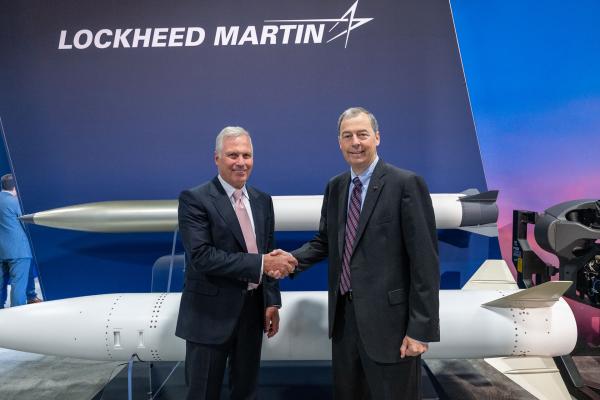
Lockheed Martin and Avio announced a strategic cooperation agreement on Oct. 13 at the Association of the United States Army annual meeting, bringing a new domestic solid rocket motor supplier into two of the Army’s most important long-range fires programs. Under the deal, Avio USA will design, build and qualify motors for the Extended-Range Guided Multiple Launch Rocket System and the Precision Strike Missile.
For Lockheed, the arrangement does two things at once. It gives the company a second source for PrSM motors and an additional source for ER GMLRS motors, both of which have leaned on a small supplier base. For the Army, it adds production depth to weapons that planners want in large numbers and on short timelines.
Avio USA chief executive Jim Syring framed the agreement as a commitment of capacity rather than a finished product. “They’re essentially reserving capacity,” he said of Lockheed, adding that the deal is a win for both companies. Tim Cahill of Lockheed said the partnership is meant to speed production and build a more diverse supply chain, two goals that have driven the Army’s munitions push for several years.
The supplier base is the heart of the story. For decades, the domestic solid rocket motor business came down to two names, L3Harris and Northrop Grumman. Both have expanded sharply, but demand from Ukraine, the Middle East and Indo-Pacific planning has outrun what two producers can supply. Newer entrants including Anduril, Ursa Major and X-Bow are now building capacity, and Avio is among the most substantial of them.
Avio USA is putting its stake in Hurt, Virginia, where it broke ground in September on a 900,000-square-foot plant. The company plans to begin motor production there in 2029. That schedule may look distant, but solid rocket motor plants take time to build, certify and qualify, and the cooperation agreement gives Avio a customer before the walls go up. Syring said that reserved capacity helps the company plan the equipment, workforce and materials it will need.
The preparation is already under way. Avio USA intends to make motor cases and nozzles in-house instead of buying them from outside, a choice that shortens the chain between raw material and finished motor. Workers are being trained for three to four months in Italy, where the parent company has decades of experience with solid propulsion. Raw materials are on order, and long-lead equipment such as mixers, ovens and X-ray inspection systems is expected to be purchased by the end of the year.
Avio’s parent, based in Italy, brings a strong record to the effort. It produces motors for the Vega launch vehicle and Ariane, and it supplies propulsion for missiles including Aster, Aspide and CAMM-ER. That portfolio gives the Virginia plant a body of proven design and process knowledge to draw on, rather than starting from a blank page. Bringing it to the United States also adds a trusted allied supplier to the domestic base.
The new agreement is not the only work Avio USA has in the pipeline. The company is developing the Mk104 motor for Raytheon’s Standard Missile, and that program is scheduled for a critical design review in spring 2027. Taken together, the ER GMLRS and PrSM work, the Standard Missile effort and the Virginia plant describe a company building a position across several major missile families at the same time.
The two Lockheed weapons covered by the deal matter for different reasons. ER GMLRS extends the reach of the rocket fired from HIMARS and M270 launchers well beyond the standard version, giving the Army a longer arm for the kind of distances that Pacific and European planners worry about. PrSM is the Army’s next-generation surface-to-surface missile, replacing the older ATACMS and designed to be fired from the same launchers. Both depend on motors that must be reliable, safe to handle and available in volume.
A second source brings practical benefits that go beyond raw numbers. When a single plant has a problem, whether a supply disruption, a quality hold or a production bottleneck, the whole program can slow. A qualified alternative gives the Army and Lockheed room to keep deliveries moving. It also creates healthy pressure on cost and schedule, since two suppliers have a reason to compete on performance.
Lockheed has been steadily widening its sourcing across its missile lines. The company has worked to bring in additional motor suppliers for GMLRS, including a partnership with General Dynamics announced in 2024, and L3Harris has just opened a new facility in Camden, Arkansas, to double its own capacity. The Avio agreement fits that pattern, adding a different kind of partner with a new facility and a long record in space and tactical propulsion.
For soldiers and allied customers, the result will be measured in deliveries. More motor sources mean more rockets and missiles can leave the factory each year, and fewer programs wait on a single supplier. The Army’s long-range fires depend on a steady flow of motors, and the Avio agreement adds a new route for that flow. Over the next few years, the Hurt, Virginia, site will show how quickly an allied company can turn a signed agreement into hardware on the line.
Source: Lockheed Martin announcement, October 13, 2026. Image: Lockheed Martin.






Leave a Reply