
By George Kaminsky
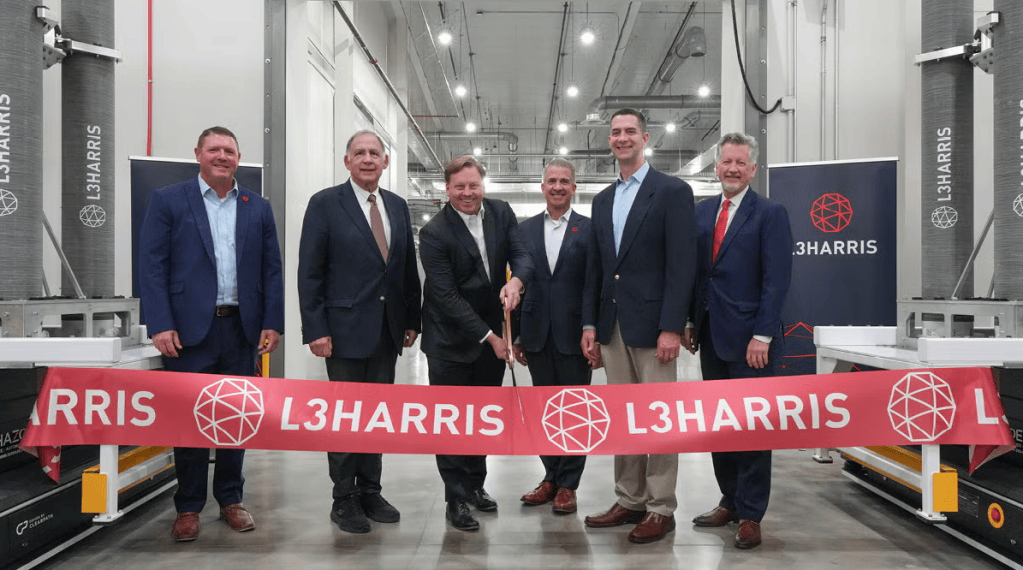
L3Harris cut the ribbon on its new Arsenal of Freedom solid rocket motor facility in Camden, Arkansas, on Oct. 20, a plant designed to double the company’s capacity in the town and feed one of the Army’s most in-demand weapons, the Guided Multiple Launch Rocket System. The opening arrived just eight days after the company learned of the largest GMLRS propulsion order in the program’s history.
The Camden site is the most visible result so far of a $216 million Defense Production Act Title III cooperative agreement signed in 2023. That agreement was built to widen the domestic base for solid rocket motors, the component that often limits how fast the United States can build missiles. Beyond Camden, the money also paid for upgrades at L3Harris facilities in Orange County, Virginia, and Huntsville, Alabama. Between them, the three locations support Javelin, Stinger and GMLRS motors.
On Oct. 12, Lockheed Martin awarded L3Harris a $250 million follow-on contract for standard-range GMLRS propulsion units. The company said the quantity is the highest it has ever received for the program. Lockheed has set a target of building 14,000 GMLRS rockets a year, and motor supply sits at the center of that goal.
The new order builds on earlier momentum. A December 2025 contract of up to $200 million covered insensitive munition propulsion units, a safer motor design intended to resist accidental ignition. In August 2024, Lockheed also announced a partnership with General Dynamics to create a second source for GMLRS motors, a sign of how seriously the program treats supply depth.
Scott Alexander of L3Harris has pointed to the pace of the ramp. The company has doubled its GMLRS motor output, and it supplies more than the motor alone. L3Harris also makes the safe-and-arm device and the proximity sensor for the rocket, which means a single supplier touches several of the parts that determine whether the weapon performs.
The Camden facility covers about 60,000 square feet and leans on automation and robotics for the work of producing motors. Camden already builds Lockheed’s HIMARS launcher, the truck-mounted system that fires GMLRS, so the town now produces both the launcher and a key piece of its ammunition.
The ribbon-cutting drew a long list of officials, a reflection of how much the project matters to the state. Michael Duffey and Ken Bedingfield spoke, along with Arkansas Gov. Sarah Huckabee Sanders, Sens. John Boozman and Tom Cotton, Rep. Bruce Westerman and the Commerce Secretary. Speakers described the plant as proof that public and private money can restore industrial capacity the country allowed to thin out after the Cold War.
Arkansas has become a hub for this work. The state is home to the Arkansas Advanced Propulsion Facilities, and L3Harris is building out a wider footprint there. The company has said it is investing billions of dollars across Arkansas, California, Virginia and Alabama, with roughly 60 facilities in the building or expansion pipeline. That includes two new propulsion facilities for the PAC-3 interceptor, the missile at the heart of Patriot air defense.
Solid rocket motors have been among the tightest chokepoints in munitions production for years. For decades, two companies, L3Harris, through its Aerojet Rocketdyne heritage, and Northrop Grumman, supplied most of the domestic output. Demand from Ukraine, the Middle East and Indo-Pacific planning pushed requirements well past what that base could deliver on short notice.
The Army has responded by trying to widen the field. New entrants such as Anduril, Ursa Major and X-Bow are building motor capacity, and Italy’s Avio is constructing a large plant in Virginia. Those efforts will take years to mature. Camden, by contrast, is a plant that is open now, and L3Harris can start filling the Lockheed order with a facility designed around the record quantity.
For the soldiers who fire GMLRS, the benefit shows up in availability. The rocket gives a HIMARS or M270 crew precision strike out to about 70 kilometers, and the extended-range version reaches much farther. A steadier supply of motors means the Army can restock after exercises and operations, and it means allies that buy the system can expect shorter waits.
The next marker is how quickly Camden moves from ribbon-cutting to full-rate production. L3Harris has said the plant is meant to double local capacity, and the Lockheed order gives it a clear volume to deliver against. Lockheed’s 14,000-rockets-a-year target depends on motors arriving on schedule, so the pace at Camden will be one of the better indicators of whether that goal is within reach.
The broader lesson is about timing. The Title III agreement was signed in 2023, the building went up in roughly three years, and the biggest order in program history arrived the same month the doors opened. That sequence is what Pentagon planners hoped to see when they started putting public money into propulsion: a facility ready at the moment demand needed it.
With Camden online, Arkansas now holds both the launcher and a growing share of the motors that power its rockets. For the Army’s fires community, that is a concrete step toward the production rates its munitions plans call for.
Source: L3Harris and Lockheed Martin announcements, October 2026. Image: L3Harris.





Leave a Reply