
By George Kaminsky
Saab has opened the doors of its new munitions plant in Grayling, Michigan, holding a soft opening for a facility that will assemble, integrate and test shoulder-fired weapons and precision strike systems for the U.S. Department of Defense. The company says buildings will be populated and production lines running by May 2027, with an official opening planned for spring 2027.
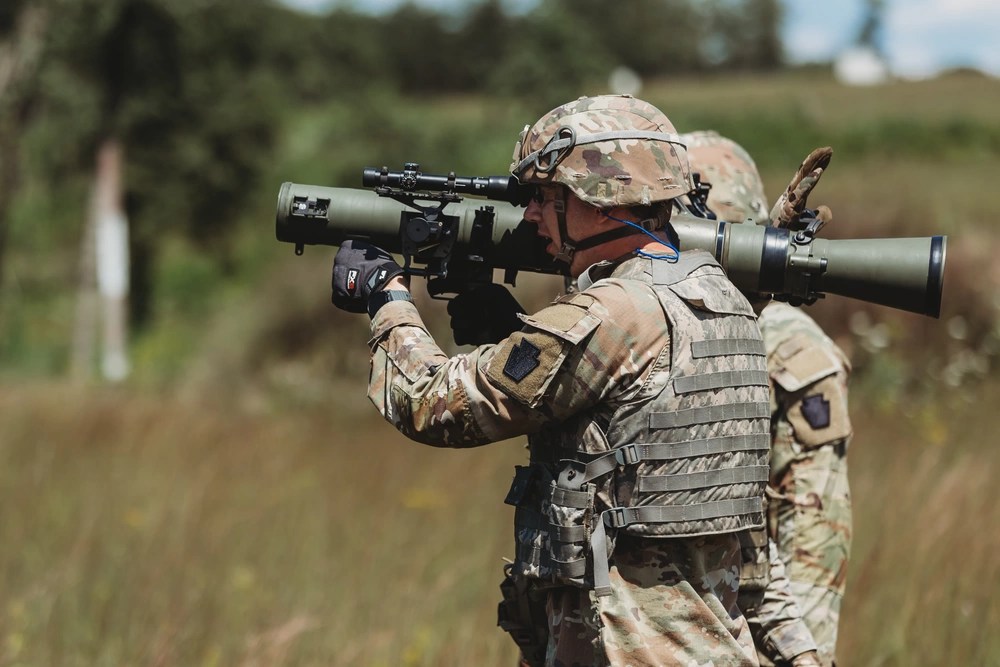
The investment is more than $115 million. The plant sits on a 445-acre property, and the first phase covers 65 acres, with room for later expansion. Erik Smith, president and chief executive of Saab Inc., said the facility will carry out final assembly, integration and test of 84 mm shoulder-fired weapons and precision strike weapon systems. The product line spans close combat weapons and medium-range rockets, the kinds of munitions ground forces rely on in volume. Eighty-four millimeters is the caliber of Saab’s Carl-Gustaf family of shoulder-fired weapons, which U.S. forces have fielded for years.
People are already at work on the site. More than 40 Michigan workers are at Grayling now, and Saab plans to add at least 30 more as it ramps up, which brings the plant to the roughly 70 jobs Gov. Gretchen Whitmer has cited since the project was announced. Saab also opened a facility in Auburn Hills in June, where nearly 20 people work, giving the company a second Michigan foothold alongside the plant in the north.
The Grayling project began in September 2024, when Saab announced it would open a munitions facility in Michigan. The company broke ground in 2025 and has moved from construction to opening in about a year. At the time, Saab said Grayling would become its 10th U.S. facility, joining sites that include West Lafayette, Indiana, which handles aerospace advanced manufacturing, Syracuse, New York, which works on radar and sensors, and locations in Rhode Island and Massachusetts that build autonomous and undersea systems.
Saab chose Grayling from six candidate sites and called it the most efficient way to do the work. The region offers an experienced manufacturing workforce, a long history of weapons production and a location near the country’s largest Army National Guard training base. The plant will also support production of components for the Ground-Launched Small Diameter Bomb system, a precision-guided weapon Saab develops with Boeing, alongside close combat weapons. That mix gives the site a role in both short-range infantry weapons and longer-range precision fires. The site was designed with room to add engineering capacity later, along with an advanced manufacturing capability and an innovation center.
The Michigan plant is part of a larger Saab effort to quadruple its capacity to produce ground combat weapons. Under the model the company has described for its U.S. sites, early engineering and manufacturing development units are built in Sweden, while the U.S. plant takes on low-rate initial production, which puts American workers and American supply chains behind the weapons that U.S. forces buy. When Saab announced the plant, Smith said the company was making a long-term commitment to the U.S. defense industrial base and to the local community. Whitmer said at the time that Michigan built the arsenal of democracy to win World War II and will keep rolling up its sleeves to protect national defense.
Political support has been visible at the opening. Rep. Jack Bergman, who represents Michigan’s 1st Congressional District, chairs the House Armed Services Subcommittee on Readiness and is a former combat Marine. He said at the event that he and the governor talk often, a sign of the state and federal coordination that large munitions projects depend on. Readiness is the subcommittee’s subject, and new capacity for close combat weapons and rockets bears directly on it.
For the Defense Department, domestic final assembly for shoulder-fired weapons and precision strike systems adds a source close to the forces that use them. Shoulder-fired weapons give infantry units an answer to armor, fortifications and other hard targets, while precision strike systems extend reach. Producing them in the United States shortens the path from factory to unit and gives planners another place to scale output if demand rises. A trained local workforce, a state with deep manufacturing roots and a site near a major Guard training base all point the same way: the plant is positioned to grow with the demand it was built to serve.
The next milestones are clear. Saab will populate the buildings and bring production lines online through the winter and spring, with production expected to start in May 2027 and the official opening to follow in the spring. Hiring continues in the meantime, and the company has room on the 445-acre site to grow beyond the first phase. Saab’s Michigan commitment now includes two sites, Grayling and Auburn Hills, and a workforce that is already growing. Details on production rates and specific delivery schedules will come as the lines come online.
Source: 9&10 News, October 27, 2026; Saab announcement, September 24, 2024; Defense News, September 24, 2024.



Leave a Reply