
By George Kaminsky
Overland AI‘s new IBEX autonomous ground vehicle is on its way into the Marine Corps’ air-defense force, backed by a production contract worth about $20 million, and the U.S. Army’s 75th Ranger Regiment has added a second order. An additional $4.5 million for the Rangers brings the combined total to about $25 million, with initial deliveries expected in 2027.
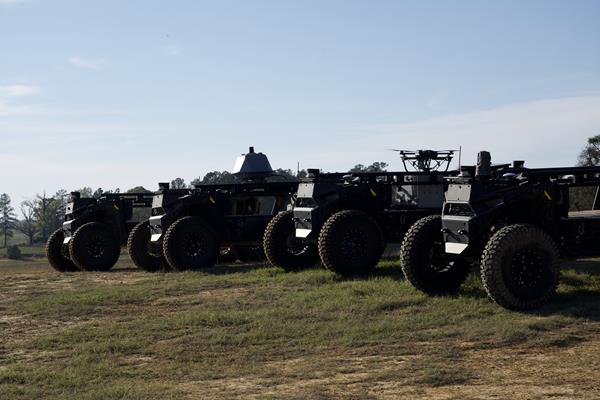
The company formally introduced IBEX on October 7 and put it on public display a few days later at the Association of the U.S. Army annual meeting in Washington. It is built on the Polaris MRZR light tactical vehicle and keeps the MRZR’s chassis, engine and drivetrain, which means units can draw on existing U.S. spare parts and maintenance channels rather than learning a new supply chain.
On paper the vehicle is a serious hauler. It weighs roughly 5,000 pounds (about 2,300 kilograms), carries a payload of about 2,000 pounds (907 kilograms) and is powered by a 1.5-liter turbocharged diesel making 120 horsepower. It tops 35 miles per hour (56 km/h) in autonomous mode and can cover about 250 miles (402 km) at a cruising speed of 20 miles per hour (32 km/h). It runs on diesel or military JP-8 fuel, supplies up to 5 kilowatts of NATO-standard 24-volt power to mission equipment, and fits aboard a V-22 Osprey for movement by air.
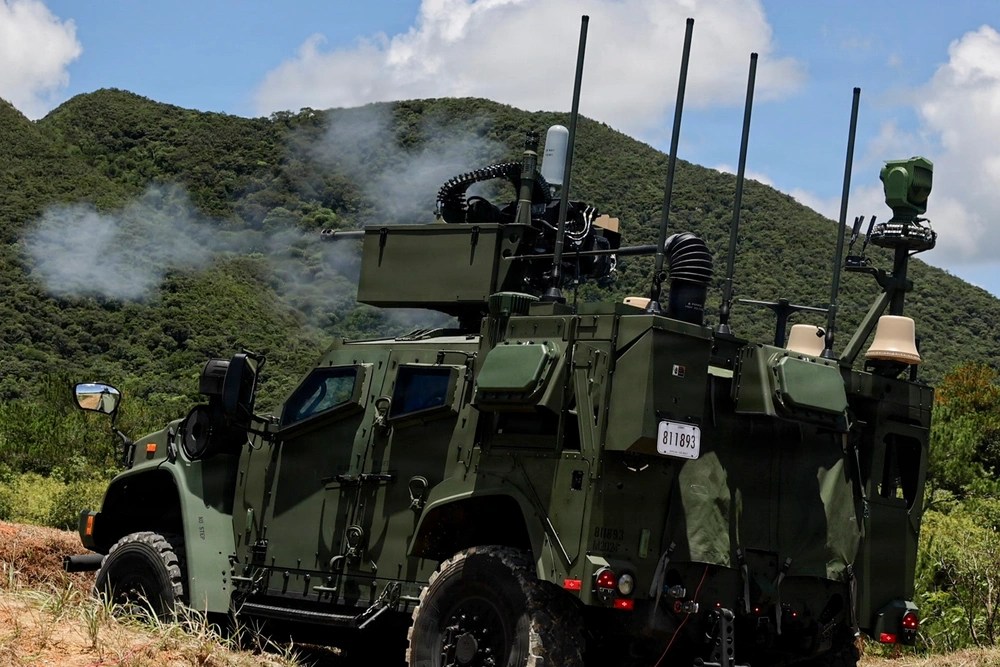
The Marine Corps assignment is built around the Marine Air Defense Integrated System, known as MADIS, which combines detection, identification, tracking and engagement against drones and other low-altitude threats. IBEX was selected for integration into that system with a straightforward purpose: moving and resupplying dispersed air-defense units while reducing the number of Marines needed for logistics. The contract was announced June 29 under the Pentagon’s Accelerate the Procurement and Fielding of Innovative Technologies initiative and was coordinated with the Marine Corps’ Ground Based Air Defense program office. Program manager Joe Klocek said the integration will extend the reach and lethality of Marine air-defense units.
The logic is practical. Air-defense teams spread out to stay hard to find, and every outpost needs fuel, ammunition and electrical power. A driverless vehicle that can carry those loads, and that exports 5 kilowatts of power at the front, takes a task off the crews who would otherwise be driving supply runs and lets them concentrate on the mission.
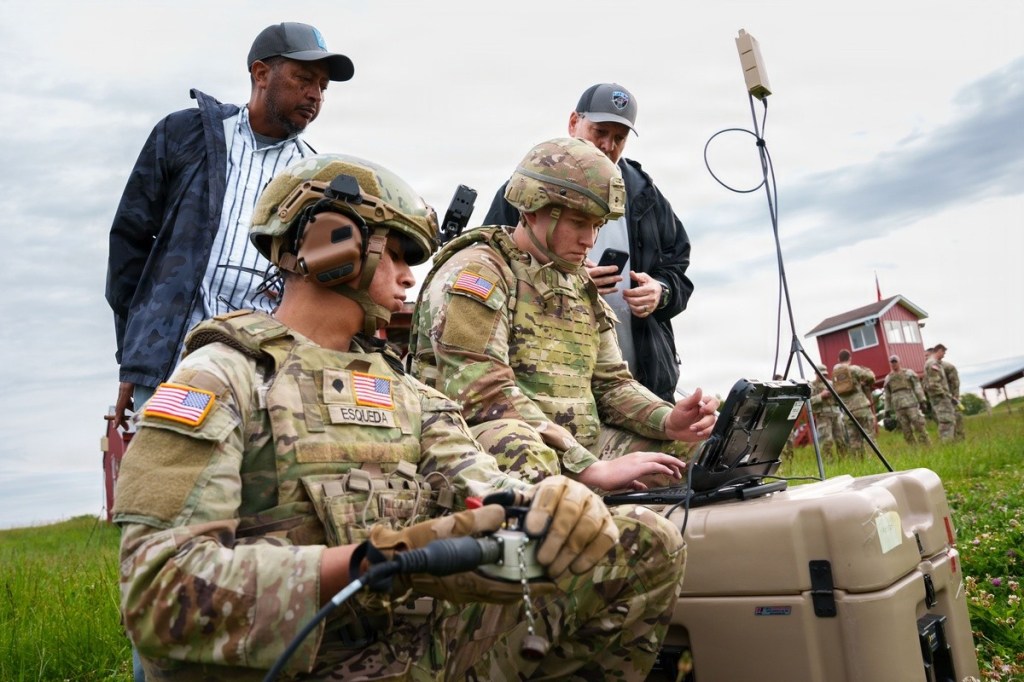
Autonomy comes from Overland AI’s own software stack: OverDrive for driving, OverWatch for the operator interface and SPARK for computing and perception hardware. The vehicle navigates without a driver or continuous remote control, including where communications or GPS are degraded or jammed. Overland AI says an operator can give IBEX a destination 10 to 50 kilometers away and the vehicle finds its own route there, and that a single operator can direct several vehicles at once.
Byron Boots, the company’s co-founder and chief executive and a University of Washington professor who directs its Robot Learning Laboratory, calls autonomy “really a game changer” because operators can describe the task and let the vehicle work out how to do it. Overland AI grew out of the Defense Advanced Research Projects Agency’s RACER program, which began in 2021, and has won about $90 million in Pentagon contracts. Soldiers and Marines are already working with its vehicles, including the 82nd Airborne Division at Fort Bragg, the 173rd Airborne Brigade in Italy, the 75th Ranger Regiment and several Marine units. In one force-on-force exercise, snipers used autonomous vehicles as decoys.
IBEX also showed what it can carry. At the Washington meeting it appeared with an Arnold Defense LAND-LGR4 launcher, which holds four 70 mm rockets and works with APKWS laser-guided munitions that turn unguided rockets into precision weapons. The launcher weighs about 27 kilograms (60 pounds) empty, has a maximum rocket range of 8 kilometers (5 miles) and a stated precision engagement range of up to 6 kilometers (nearly 4 miles). Overland AI is also working to bring its autonomous driving to the Marine Corps’ ROGUE Fires system, which is intended for expeditionary anti-ship strikes.
The vehicle’s listed roles run well beyond weapons. They include hauling ammunition, fuel and supplies, carrying surveillance, communications, electronic warfare and counter-drone equipment, and evacuating casualties, all without putting a driver at the wheel.
Boots has been plain about why this field took time to mature. Ground robots have entered service more slowly than aerial drones because rough terrain demands that a vehicle understand the ground beneath it and control itself across it. “The ground is the most important domain,” Boots said, and the vehicles reaching units now reflect years of work on that problem. Army leaders are moving in the same direction. Gen. Christopher LaNeve, the acting chief of staff, announced the new Army Futures and Autonomous Systems Command, and the service wants to put autonomous vehicles in front of more units at every echelon of the force.
With initial deliveries expected in 2027, the next milestones are the first IBEX vehicles reaching Marine air-defense units and the Rangers, along with further integration work on MADIS. For a company that began as a research effort on off-road autonomy, a production contract, a second service customer and a place in a named Marine program mark a quick move from prototype to fielded system. Details on delivery schedules and quantities will come as the programs advance.
Source: Army Recognition, October 21, 2026; Stars and Stripes, October 28, 2026; The Defense Post, October 13, 2026.



Leave a Reply