
By George Kaminsky
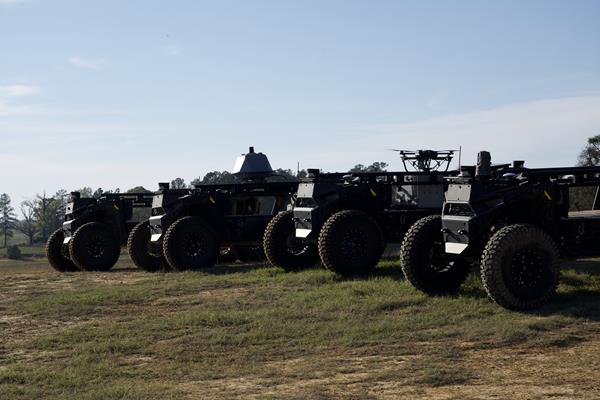
Forterra has put its AutoDrive autonomy software on a second kind of military vehicle, installing it on Hypercraft’s Razorback ground vehicle for a joint debut at the Association of the U.S. Army annual meeting in Washington. The Clarksburg, Maryland, company also has a mine-clearing truck, the Mobile Autonomous Uncrewed Lanemaker, or MAUL, that defended itself against attacking drones at Fort Bragg this summer. Together the two vehicles show how far autonomous ground systems have moved beyond demonstration.
The Razorback is built for contested environments. It is rated at 300 horsepower, has a range of 500 miles and can distribute up to 38 kilowatts of power to mission equipment, a figure that matters as soldiers add sensors, jammers and other electronics to their vehicles. Forterra’s chief growth officer, Scott Sanders, said the purpose of an autonomous military vehicle is to deliver payloads to the point of friction, the place where the fight is actually happening.
AutoDrive arrives with a record behind it. Forterra says the software is installed on more than 200 vehicles in active service and that it was the first U.S. ground autonomy company actively deployed in Ukraine, where it has completed 88 casualty evacuation missions to bring wounded soldiers off the front line. Company spokesperson Kelsey Szablowski sums up the appeal in three words: “Robots don’t bleed.”
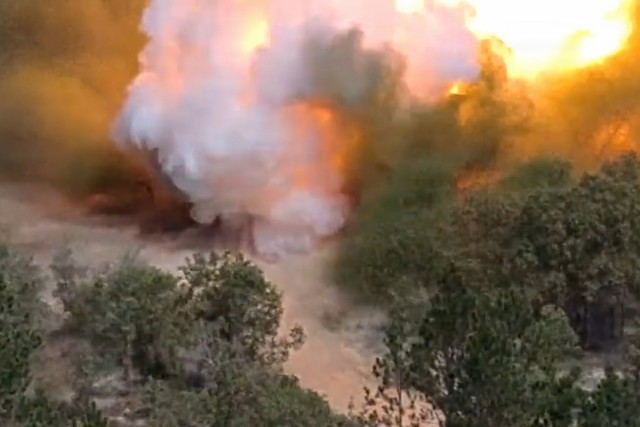
The MAUL shows the other side of the company’s work. It is built on a Ford F-250 pickup truck fitted with AutoDrive, with no human in the driver’s seat, and it can drive itself or be controlled by an operator. Its job is reconnaissance, planning and clearing in areas contested by mines. To clear a lane, it deploys a rocket-propelled mine-clearing line charge that detonates explosives ahead of the vehicle before it drives through.
Breaching is among the most dangerous tasks in land warfare, because the people doing it work closest to the obstacles and the enemy fire that covers them. A truck that can scout a route, fire the charge and then drive the cleared lane on its own moves that exposure from soldiers to a machine. It also fits the Army’s push to field autonomous capability at operational speed rather than keep it in the laboratory.
That push was on display at Project Sandhills, the Army’s experimentation effort at Fort Bragg, North Carolina, which ran August 17 to 28. Forterra demonstrated the MAUL in mid-August. Drones attacked the vehicle while it performed mine detection and clearing, and the MAUL destroyed them with an onboard automated turret while it continued to navigate autonomously. Capt. Denny Drummey, the Sandhills operations officer, described the broader idea as fielding semi-autonomous F-250 trucks and swarms of small drones in place of relying only on high-value crewed assets.
The Army has backed the approach with contracts. Forterra was selected as a prime contractor for the service’s Engineer Autonomous Breaching Capability program, which aims to field autonomous vehicles for mine clearing. On July 31 the company announced a second Sandhills prime contract, covering autonomous breaching and terrain shaping operations under the Sandhills 2.0 effort. The Department of War launched that effort to speed the move from prototyping to operational fielding, building on the first Sandhills project to expand the Army’s ability to breach and shape obstacles in contested environments, and Forterra’s F-250 trucks carry integrated mission systems that bring in commercial technologies from partner companies for threat identification, breaching, counter-mobility and counter-drone defense. Forterra holds more than $100 million in Pentagon contracts for autonomous breaching and multimission ground vehicles.
Pat Acox, the company’s vice president for defense growth, framed the goal in terms of results rather than hardware. “Soldiers don’t employ products. They employ effects,” he said, and the Army, he added, needs integrated autonomous mission capability delivered at operational speed.
Forterra is far from the only company in the field. Overland AI, Scout AI and others are also winning Pentagon work, and the Army’s new Futures and Autonomous Systems Command, announced by acting chief of staff Gen. Christopher LaNeve, is charged with leading the service’s adoption of autonomy. The service wants more units testing autonomous vehicles and plans to bring them to every echelon of the force. That demand gives companies with fielded vehicles, like Forterra with more than 200 in service, a strong starting position.
What comes next is a matter of scale and variety. The Razorback pairing shows AutoDrive can move between vehicle types, which matters to buyers who want one autonomy stack across many platforms. The MAUL’s drone-defense result shows a breaching vehicle can protect itself while it works. With the Engineer Autonomous Breaching Capability program and Sandhills 2.0 both under way, the next steps are further soldier trials and fielding decisions, and the MAUL’s turret result gives those trials a strong data point to build on. Details on those schedules will come as the Army moves from experiments toward fielding.
Source: Defense News, October 14, 2026; Forterra announcement, July 31, 2026; Stars and Stripes, October 28, 2026.



Leave a Reply