
By George Kaminsky
At the Army’s annual meeting in Washington last week, two messages about military autonomy were delivered within a day of each other. Defense Secretary Pete Hegseth said the Pentagon is seeking roughly $50 billion in reconciliation funding to scale autonomous and robotic systems, with the goal of growing the stockpile of autonomous weapons from thousands of units into the millions. Army Under Secretary Mike Obadal told the same audience that keeping a human in the loop remains the default for AI on the battlefield. Together they show where the policy line sits: far more machines, with a person still expected to make the lethal decision.
Hegseth spoke on October 14 at a panel on Project Agincourt, the interim effort the Pentagon is using ahead of the planned Autonomous Warfare Command. Defense News reported the roughly $50 billion figure in its conference recap. Other reporting puts the autonomy request differently: the Defense Autonomous Warfare Group’s fiscal 2027 ask has been reported at nearly $54 billion, including an additional $53.6 billion sought through reconciliation, alongside a separate $1 billion in the regular budget that congressional defense committees have been weighing. The figures do not match exactly, and the underlying budget documents were not cited in the coverage reviewed, so the safest reading is that the request is in the neighborhood of $50 billion and that its precise structure is still being defined.
The money rides on a vehicle that has not passed. Political.org reported on October 18 that the broader $350 billion reconciliation package, which would also fund Golden Dome missile defense and expanded munitions production, had not been approved and had no clear path in the Senate. The Pentagon’s overall request is $1.5 trillion, split between a base budget of about $1.15 trillion and the reconciliation package. Hegseth said $350 billion is a minimum and that the administration would push for at least that amount regardless of the midterms, adding that he would prefer to use the regular budget process but would use reconciliation if he could not. The Pentagon comptroller, Jay Hurst, has noted that if reconciliation fails the request could shift into the base budget, which would likely require cuts elsewhere. Those details come from a single secondary outlet and should be confirmed against primary sources.
The human-control statement is the quieter and arguably more consequential item. Obadal said a human in the loop remains the default for AI on the battlefield. He did not, in the reporting available, describe what happens when the default is not applied, which weapons or missions are exceptions, or who can approve one. A default is a policy preference, not a guarantee, and that distinction will matter as machines get cheaper and faster. When a drone can find and strike a target in seconds, and an adversary’s jamming cuts the link to the operator, the pressure to let software decide grows.
Other policy moves at the meeting fit the same picture. An October 1 memo signed by Acting Army Secretary Adam Telle directs the vice chief of staff to establish the U.S. Army Futures and Autonomous Systems Command and tells the assistant secretary for acquisition to create a single office to buy priority autonomous systems. Telle said the Army is cutting its service fiefdoms from thousands to a few newly named portfolio acquisition executives. Obadal also discussed a high-low mix of exquisite and affordable munitions and faster acquisition, which is the commercial logic behind buying autonomy in volume.
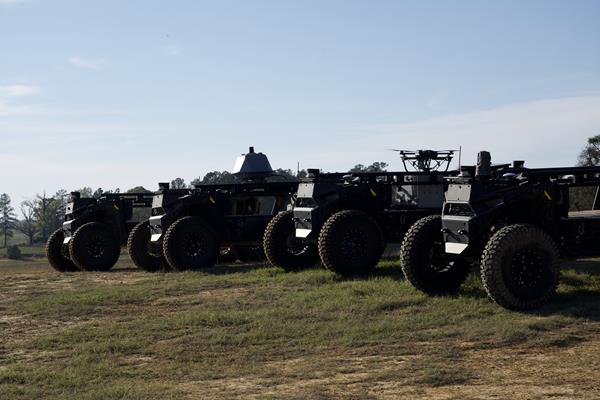
The hardware at the show matched the rhetoric. Sig Sauer and Israel Aerospace Industries announced a test in which a heavy-duty quadcopter carrying Sig’s M250 light machine gun identified and engaged targets from the air. The drone, IAI’s Fire Storm 250, can stay airborne for two hours and has a stabilized gun mount. Powerus unveiled a fully autonomous version of its Guardian interceptor. Forterra installed its AutoDrive autonomy software on Hypercraft’s Razorback ground vehicle for contested environments. Northrop Grumman showed Raid Hunter, a 50mm gun air-defense system with AI targeting and proximity-fuzed rounds built for drone swarms and cruise missiles.
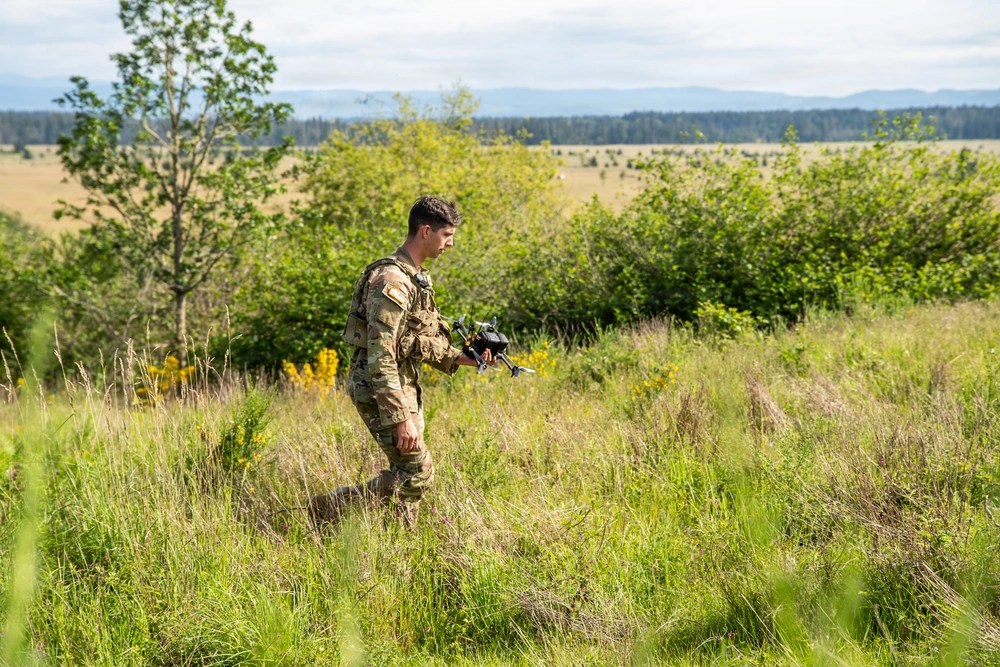
Training and acquisition are moving too. At Fort Bragg, XVIII Airborne Corps soldiers planned flight routes and flew Bumblebee V2 small unmanned aircraft in Project Sandhills 2.0, testing unmanned support for breaching contested obstacles. On October 13, representatives of Canada, Croatia, Egypt, Japan, Kuwait, Morocco, Albania and Panama signed statements of intent to join the Army’s online drone-acquisition marketplace, which has processed $800 million in transactions since it launched. The Defense News headline cited 33 nations, but the article text names only those eight.
The questions to track are specific. Does Congress pass the reconciliation package, or does the autonomy money shrink into the base budget? Does the Pentagon publish the conditions under which a human can be taken out of the loop, and who can authorize them? And does the first autonomous-weapon stockpile target of “millions” get a delivery schedule? Until those answers arrive, the announcements describe an ambition: a large request on an uncertain legislative path, and a stated rule about human control that has not yet been tested by the pace the same officials want to set.
Source: Defense News AUSA recap, October 16, 2026; Political.org, October 18, 2026.



Leave a Reply