
By George Kaminsky
Lockheed Martin and General Dynamics have fired a newly built solid rocket motor for the Guided Multiple Launch Rocket System, the first reported hardware test in an effort to give the Army a second domestic source of propulsion for its workhorse precision rocket. Tim Cahill, president of Lockheed Martin Missiles and Fire Control, disclosed the firing in an interview reported on October 9. He said the motor had been loaded with propellant and fired several days earlier.
The companies have not said when or where the test took place, how the motor performed, or whether it has entered qualification for production ammunition. What the firing does show is that the effort has moved from factory preparation to live propulsion testing.
The motor is a Lockheed Martin design, loaded with solid propellant through the company’s industrial partnership with General Dynamics Ordnance and Tactical Systems. That partnership dates to an August 2024 teaming agreement under which General Dynamics committed to build solid rocket motors for GMLRS at its Camden, Arkansas, facility.
The firing involved a standard GMLRS motor. The companies have not confirmed whether the same propulsion work is intended for the Extended-Range GMLRS, which uses a larger motor to reach roughly 150 kilometers, more than twice the base rocket’s 70.
A static or live motor firing typically checks the basics: that the propellant burns as designed, that the case holds pressure, and that thrust over time matches the model. It is an early gate, not the last one. Motors headed for real rockets are normally fired repeatedly, across temperature extremes and after storage, before a customer accepts them. The companies have said nothing publicly about where this motor stands in that sequence.
A GMLRS round is more than its motor, but the motor is the part that is hardest to scale. Solid rocket motors need specialized casting, testing and qualification before they can ship, and a rocket line cannot deliver finished rounds faster than it receives motors, guidance sections and warheads. Reporting in August described a shortage of rocket motors as a complication in replenishing Army stocks, which have been drawn down by deliveries to Ukraine and a prolonged conflict with Iran.
Northrop Grumman and L3Harris have historically carried much of the load in U.S. tactical missile propulsion. A General Dynamics motor line in Arkansas would add another name to that list and make the GMLRS supply chain less dependent on any single supplier.
The industrial question has a number attached. Lockheed Martin has said it is raising GMLRS capacity to 14,000 rockets a year. In August, the Army issued a sources-sought notice for 133,014 GMLRS rockets by 2034, which works out to about 19,000 a year across all variants, including the extended-range round. That is nearly 36 percent above Lockheed’s stated capacity. Deliveries under the notice would begin in 2030, although Army leaders have considered getting the quantity as early as 2028. Industry white papers were due September 1, and the Army asked respondents to lay out the most efficient and cost-effective way to reach the rate.
Those figures are a planning requirement, not a contract. No award has been announced.
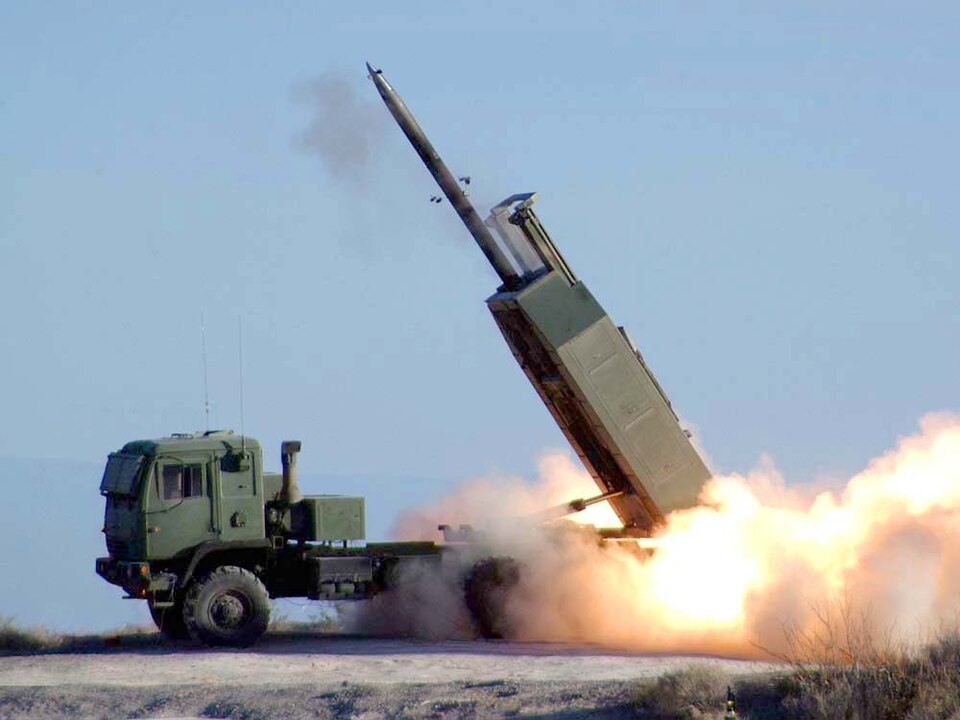
GMLRS is fired from the wheeled M142 HIMARS, which carries one pod of six rockets, and the tracked M270, which carries two pods for 12. The base rocket uses inertial and GPS guidance to strike targets beyond 70 kilometers. The unitary version carries a roughly 90-kilogram high-explosive warhead for point targets, while the alternative-warhead version uses fragmentation effects against dispersed targets such as troop concentrations and vehicles.
The rocket became one of the best-known weapons of the war in Ukraine, where it has been used against command posts, depots and artillery positions. That wartime use is a major reason stockpile depth has become a planning issue as much as launcher count.
The firing is an intermediate milestone. Before General Dynamics motors can support routine deliveries, they must show consistent performance, repeatable manufacturing and compliance with qualification standards. Neither company has given a date for that process or said how many motors the arrangement could eventually produce each year.
The next signals are concrete: disclosure of test results, a qualification schedule, a stated annual motor capacity, and an Army decision on how it will meet the 19,000-a-year requirement. Until those appear, the second motor source is a promising supplier-side step and not yet added capacity.
The redundancy argument is straightforward even without those numbers. A line that depends on one motor source can be stopped by a single qualification problem, a plant outage or a materials shortage. Two sources do not double output automatically, but they give planners somewhere to turn when one stumbles, and that resilience matters more as the Army asks industry to build rockets at a pace it has never sustained.
Source: Army Recognition reporting of Lockheed Martin comments, October 11, 2026; U.S. Army sources-sought notice as reported by Defense News, August 18, 2026.





Leave a Reply