
By George Kaminsky
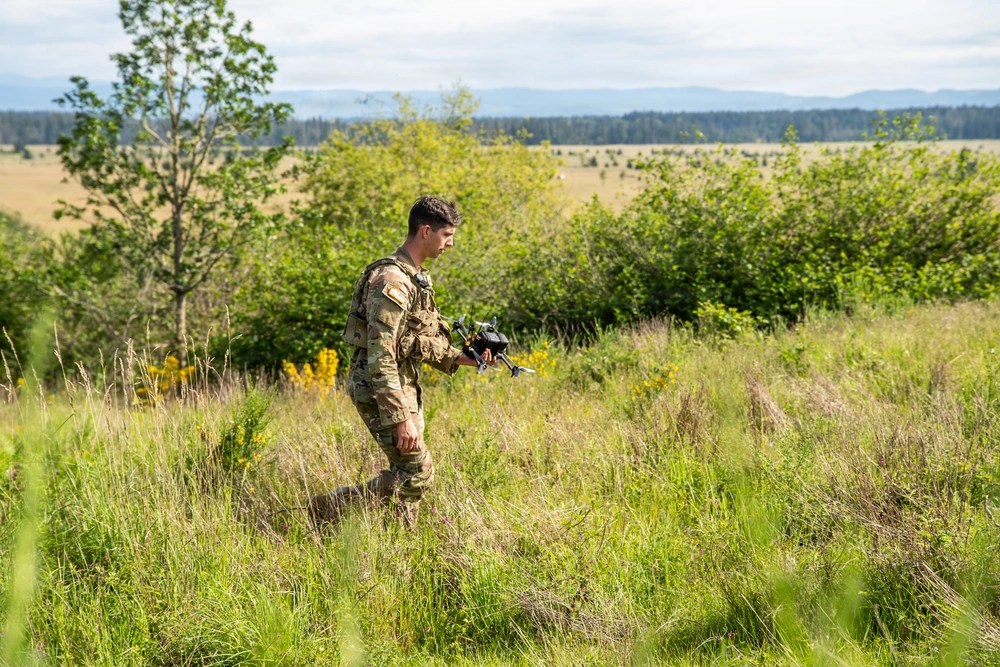
First Breach Inc. (NASDAQ: FBDT), a Hagerstown, Maryland, ammunition maker that is building an unmanned aircraft business, announced on October 13 that its proprietary drone prototype has completed its first autonomous flight. The company says the aircraft took off, followed a predetermined route using satellite navigation, returned and landed without manual control input from a pilot.
It is the third flight milestone the company has announced in about seven weeks, after a first flight in late August and an untethered flight on September 23. “Untethered flight showed we had a vehicle. Autonomous flight shows we have a system,” said Jeffrey Low, co-founder and chief executive officer. “The aircraft was given a mission and it executed that mission on its own, from takeoff to landing.”
First Breach says the mission validated the full autonomy loop of guidance, navigation and control on the current prototype. The flight ran on Betaflight, an open-source flight control firmware widely used on small hobby and racing drones, on which the company’s own flight controller was first brought up. The release does not say whether the aircraft carried that in-house controller or the commercial flight electronics used in the September flight.
The company is now porting its flight stack to PX4, an open-source autopilot used across defense, industrial and research unmanned systems. First Breach says PX4’s mission planning, failsafe and sensor integration framework is the base for the more complex mission profiles and payload behaviors it wants to support. The port is in process and runs alongside continuing airframe and electronics changes.
A small drone that needs a pilot on the sticks for every second of flight ties up an operator and depends on a live link to stay on course. A drone that can run a route on its own changes that arithmetic. One person can plan a mission instead of flying it, and the aircraft has a defined behavior if instructions stop arriving. First Breach has not said how its prototype handles a lost control link, which is the kind of behavior a failsafe framework like PX4’s is meant to define, but a closed autonomy loop is the precondition for that work.
The prototype is a four-rotor Class 1 platform weighing about 2.2 kg, with a payload capacity of roughly 500 g through a Picatinny rail and an electrical interface. The company lists an effective range of 2 km, endurance of about 10 minutes, a cruise speed of 50 km/h and a top speed of 120 km/h. Navigation uses GNSS with visual-inertial augmentation. The control link is 900 MHz MAVLink, the batteries are swappable LiPo packs, and the aircraft is designed for field assembly in under ten minutes. First Breach describes the build as a proof of concept whose specifications may change before production.
Those figures place it among the short-sortie, low-cost small drones that armed forces now buy in large numbers. The Picatinny rail is the notable choice: it is the standard mounting interface on military small arms, which suggests the company intends the aircraft to carry modular payloads rather than only a camera. The release does not name a payload, a customer or a mission.
First Breach is better known for ammunition. The company has said new high-speed loading and inspection equipment at its Hagerstown site raised ammunition capacity by about 175 percent, to as many as 20 million rounds a month, and that it holds more than 200,000 contiguous square feet set aside for drone production, robotic assembly and automated logistics. The drone program runs under an agreement with Hellbender, an engineering and manufacturing firm that provides design, technical support and component production. First Breach says it owns the platforms and their intellectual property and controls manufacturing and sales.
The company has described two Class 1 attritable platforms, a compact close-quarters system and a longer-range one, built on shared components to simplify the supply chain. The release does not say which of the two the autonomous prototype represents. Attritable means cheap enough to lose in use, the design goal behind the 2,500-a-week target.
The schedule has not changed. First Breach still aims to complete initial prototypes in the fourth quarter of 2026 and begin scaled production in the second quarter of 2027, with a targeted capacity of more than 2,500 drones a week. Brett Phillips, Hellbender’s chief revenue officer, said the program is “advancing mission capabilities and preparing the platform for volume manufacturing on American soil.”
The next checkpoints are concrete: the same mission flown on PX4, a flight on the in-house controller, a flight with a payload on the rail, and the completion of initial prototypes in the fourth quarter. Each would turn a described test into a measured one, and a first government customer would show whether the volume target has a buyer.
Source: First Breach company announcement, October 13, 2026.



Leave a Reply